

Every year brings a shift in what feels current and what feels like it has had its moment, and kitchen design is no exception. 2026 has a clear direction. The move is away from kitchens that announce themselves loudly — through dramatic colour choices, heavily styled surfaces and maximalist hardware — and towards spaces that feel considered, warm and genuinely liveable. If you are planning a new kitchen this year, understanding where design is heading will help you make decisions that feel relevant now and hold up well over time. It is a central part of every bespoke kitchen design conversation we have with homeowners at Studio K.
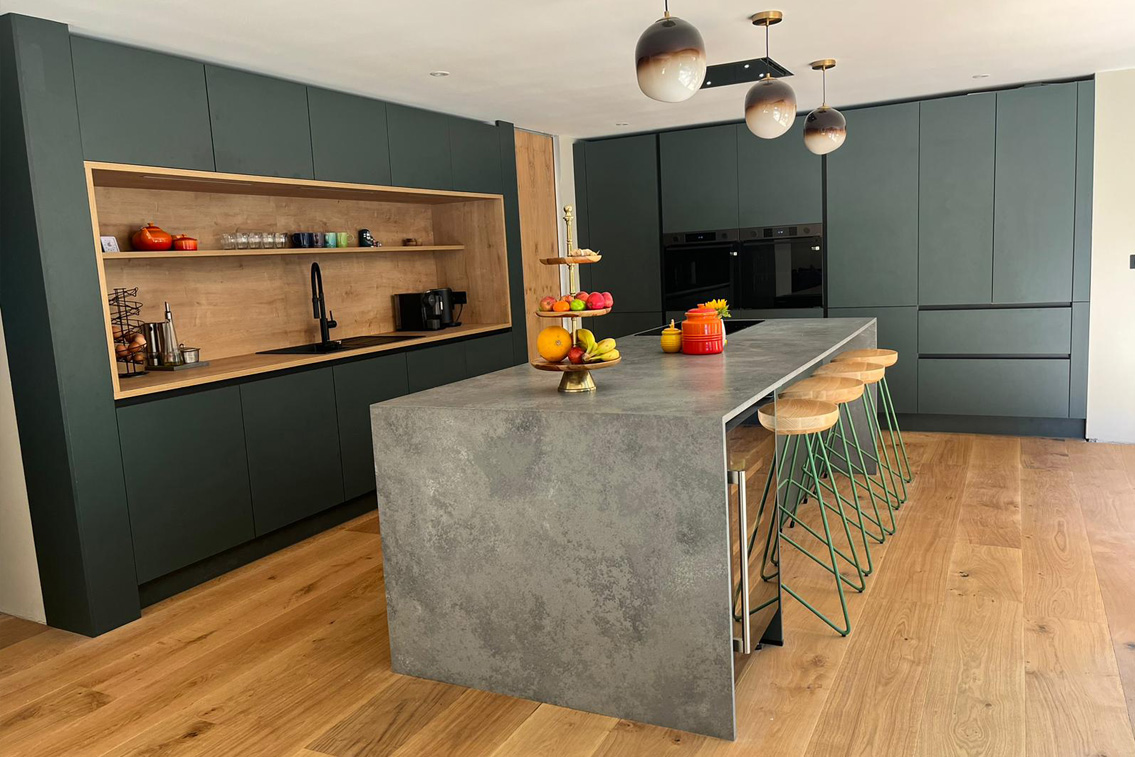
The cool grey kitchen that dominated for the better part of a decade has given way to warmer tones. Warm whites, soft taupes, aged linens and muted earthy greens are replacing the cooler greys and stark whites that characterised much of the previous decade’s output. The shift reflects a broader move in interior design towards spaces that feel inviting rather than architectural. Kitchens are being designed to feel like rooms people want to spend time in, not just functional spaces optimised for efficiency. This is closely connected to how you approach colour selection more broadly — the warmer palette is also the one most likely to age well.
Stone, timber and unlacquered metals are all having a sustained moment. Honed rather than polished stone worktops, visible wood grain on cabinet interiors, and aged brass or unlacquered copper hardware all contribute to kitchens that feel grounded and tactile. The appeal is partly aesthetic and partly a reaction against the highly processed, almost synthetic quality of some of the highly polished kitchens of the mid-2010s. Natural materials age in ways that are often beautiful rather than simply worn — though they typically sit at the higher end of the spec, which is why understanding what drives your kitchen budget matters when planning the material palette.
Lighting in kitchens has become significantly more sophisticated. The move is away from a single overhead fitting supplemented by under-cabinet LEDs and towards layered lighting schemes that treat the kitchen with the same seriousness as any other room in the house. Pendant lights over islands, integrated lighting within tall cabinets, and warm-toned rather than cool-toned LEDs throughout are all features that characterise well-designed kitchens in 2026.
Open shelving had a long run. The appeal was clear — it made kitchens feel lighter and more informal, and it suited the pared-back aesthetic that was dominant for much of the previous decade. But its practical limitations are increasingly acknowledged. Open shelves require constant maintenance, they attract grease and dust, and they demand a level of visual curation that most households find difficult to sustain. Closed storage with considered internal organisation is reasserting itself as the more practical and more genuinely useful approach.
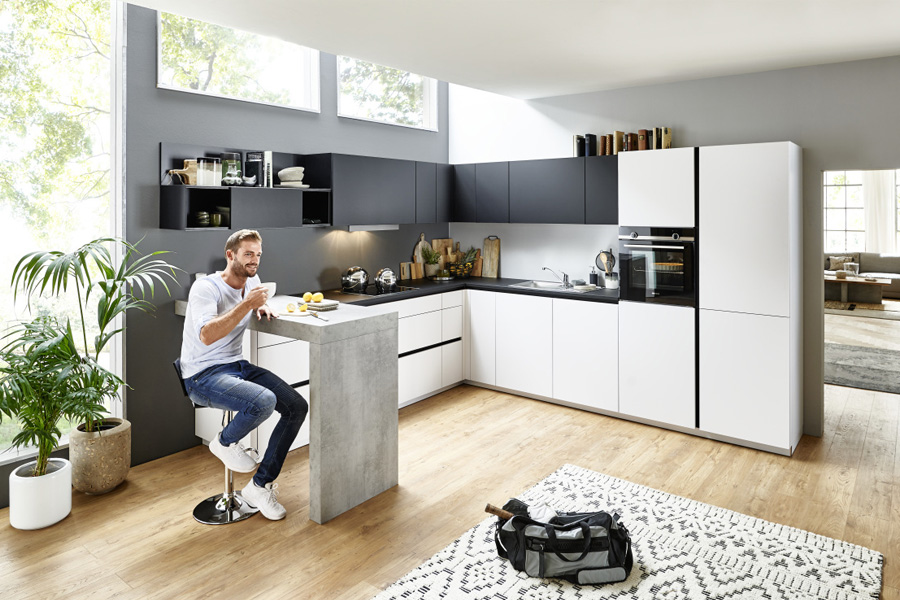
The all-matching kitchen is giving way to spaces that use contrast and material variation more confidently. Two-tone cabinetry, mixed hardware finishes and the combination of different worktop materials in the same kitchen are all expressions of a more relaxed and more individual approach to bespoke kitchen design. This is one of those areas where the most commonly repeated design rules are worth questioning — matching for matching’s sake produces flat, undifferentiated kitchens.
Handleless kitchens remain popular and will continue to be — they suit certain architectural styles and certain lifestyles very well. But the assumption that handleless is automatically more modern or more sophisticated is being challenged. Well-chosen hardware — whether a simple bar handle, a cup pull or an integrated rail system — can add as much to a kitchen as it takes away, and designers are increasingly comfortable recommending hardware that suits the brief rather than defaulting to handleless as the premium option.
Working with a designer who understands where bespoke kitchen design is heading — and who can distinguish between trends worth following and those best avoided — is one of the clearest advantages of a considered design process. The kitchens that will look best in ten years’ time are the ones being designed thoughtfully now, with warmth, material honesty and a willingness to question outdated rules.
If you are ready to start planning your new kitchen for 2026, our design team is here to help. Contact Studio K Kitchens to book a consultation at either of our UK showrooms.